


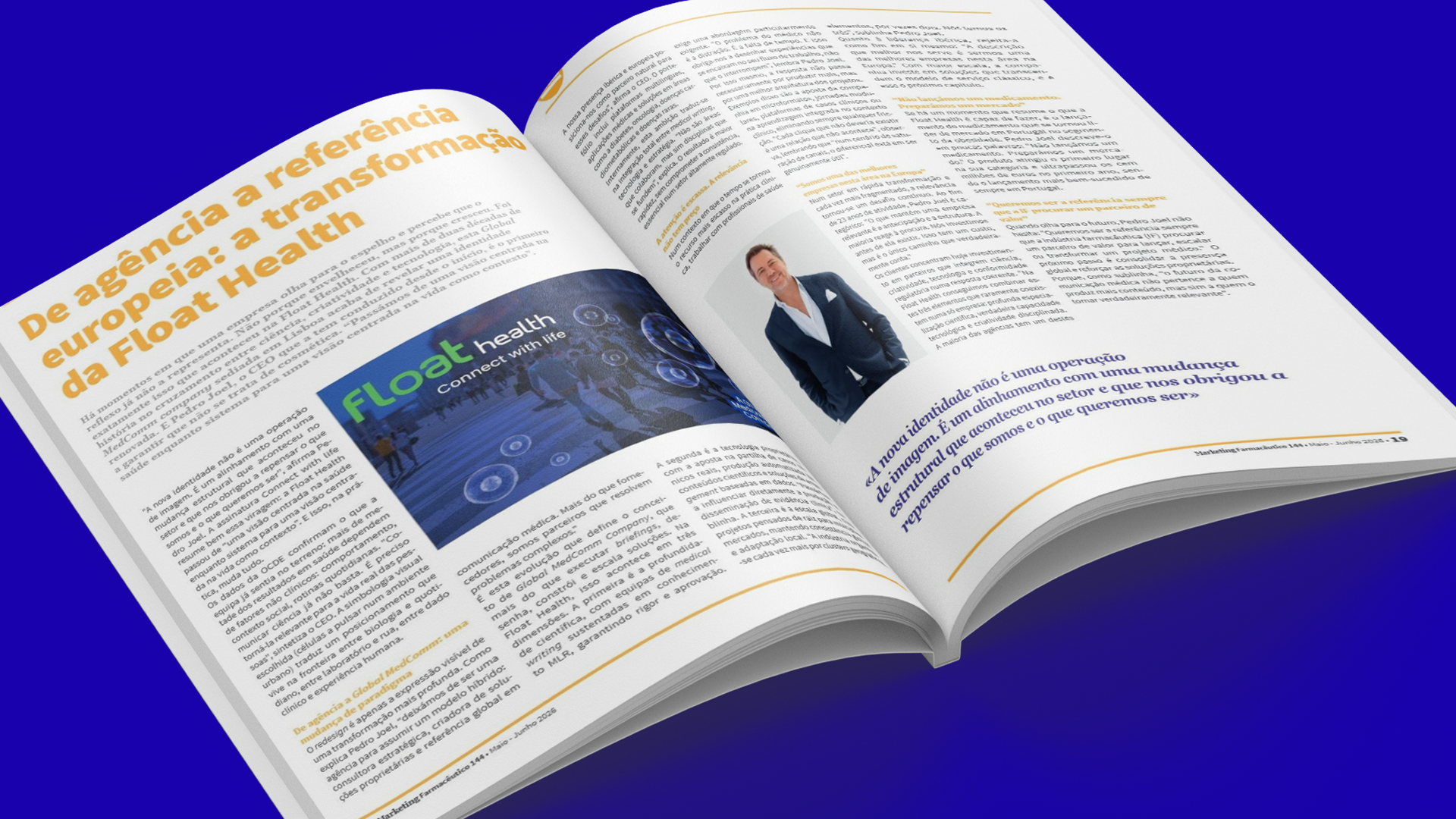
There are moments when a company looks in the mirror and realises that its reflection no longer represents it. Not because it has aged, but because it has grown. That is exactly what happened at Float Health. With more than two decades of history at the intersection of science, creativity and technology, this Lisbon-based Global MedComm company has just unveiled a renewed identity. And Pedro Joel, the CEO who has led it from the outset, is the first to ensure that this is not merely cosmetic. “We have moved from a system-centred view of health to a life-centred perspective.”
“The new identity is not an image exercise. It is an alignment with a structural shift that has taken place in the sector and that has forced us to rethink what we are and what we want to be,” says Pedro Joel. The tagline Connect with life neatly summarises this journey: Float Health has moved from “a system-centred view of health to a life-centred perspective”. And that, in practice, changes everything.
OECD data confirms what the team was already experiencing on the ground: more than half of health outcomes depend on non-clinical factors: behaviour, social context and daily routines. “Communicating science is no longer enough. It needs to be made relevant to people’s real lives,” the CEO summarises. The chosen visual symbolism (cells pulsing in an urban environment) reflects a positioning that sits on the boundary between biology and everyday life, between the laboratory and the street, between clinical data and human experience.
From agency to Global MedComm: a paradigm shift
The redesign is merely the visible expression of a deeper transformation. As Pedro Joel explains, “we have moved from being an agency to adopting a hybrid model: a strategic consultancy, a creator of proprietary solutions and a global reference in medical communication. More than suppliers, we are partners who solve complex problems.”
This evolution defines the concept of a Global MedComm Company, one that goes beyond executing briefs to designing, building and scaling solutions. At Float Health, this happens across three dimensions. The first is scientific depth, with medical writing teams grounded in MLR expertise, ensuring rigour and compliance. The second is proprietary technology, with a focus on sharing real clinical cases, the automated production of scientific content and data-driven engagement solutions. “We have moved to directly influencing the production and dissemination of clinical evidence,” he highlights. The third is global scale, with projects designed from the outset for multiple markets, maintaining global consistency while enabling local adaptation. “The industry is increasingly organised around geographic clusters.”
“Our Iberian and European presence positions us as a natural partner for these challenges,” says the CEO. The portfolio includes multilingual platforms, medical applications and solutions in areas such as diabetes, oncology, cardiometabolic diseases and rare diseases. Internally, this ambition translates into full integration between medical writing, technology and strategy. “These are not areas that collaborate, they are disciplines that merge,” he explains. The result is greater speed without compromising consistency, which is essential in a highly regulated sector.
Attention is scarce. Relevance is priceless
In a context where time has become the scarcest resource in clinical practice, working with healthcare professionals requires a particularly demanding approach. “The doctor’s problem is not distraction. It is lack of time. And that forces us to design experiences that fit into their workflow, rather than interrupt it,” Pedro Joel notes. For that reason, the response is not necessarily to produce more, but to build better project architecture. Examples include the company’s focus on micro-formats, modular journeys, clinical case platforms and learning integrated into clinical practice, always eliminating friction. “Every click that should not exist is a relationship that does not happen,” he observes, adding that “in a saturated channel environment, the differentiator lies in being genuinely useful.”
“We are one of the best companies in this field in Europe”
In a rapidly transforming and increasingly fragmented sector, relevance has become an ongoing challenge. After 23 years of activity, Pedro Joel is unequivocal: “What keeps a company relevant is anticipation and structure. Most react to demand. We invest before it exists. That has a cost, but it is the only path that truly matters.”
Clients are now concentrating investment on partners that integrate science, creativity, technology and regulatory compliance into a coherent offering. “At Float Health, we have managed to combine these three elements that rarely coexist in a single company: deep scientific expertise, true technological capability and disciplined creativity. Most agencies have one of these elements, sometimes two. We have all three,” emphasises Pedro Joel.
As for Iberian leadership, he rejects it as an end in itself: “The description that suits us best is being one of the best companies in this field in Europe.” With greater scale, the company is investing in solutions that go beyond the traditional service model and that is the next chapter.
“We don’t launch a medicine. We prepare a market”
If there is one moment that encapsulates what Float Health is capable of, it is the launch of the medicine that became the market leader in Portugal in the obesity segment. Pedro Joel describes it succinctly: “We don’t launch a medicine. We prepare a market.” The product reached first place in its category and exceeded €100 million in its first year, becoming the most successful launch ever in Portugal.
“We want to be the reference whenever pharma is looking for a value partner”
Looking to the future, Pedro Joel is clear: “We want to be the reference whenever the pharmaceutical industry is looking for a value partner to launch, scale or transform a medical project.” The next step is to consolidate global presence and strengthen proprietary solutions. Because, as he emphasises, “the future of medical communication does not belong to those who produce more content, but to those who make it truly relevant.”
Marketing Farmacêutico 144 · May–June 2026 · pages 18–19